


Meta CEO Mark Zuckerberg recently approved a round of layoffs in the AI division affecting about 600 employees. This marks Meta’s largest restructuring in the AI space this year, primarily impacting the company’s core research and development arm.
Yuandong Tian, who was leading a team at Meta’s FAIR (Fundamental AI Research), confirmed on the social media platform X: “Some of my team members and I were affected by these layoffs.” As FAIR is one of the core pillars of the “Meta AI” research ecosystem, Tian’s departure has drawn widespread attention across the industry.
In his first public appearance since the news broke, Tian sat down for an exclusive, in-depth interview with me (YZ).
Facing industry speculation, Tian took this opportunity to clarify and set the record straight: his team made substantial and critical contributions to Meta’s large model development. The biggest challenge they faced, he explained, wasn’t technical but was actually convincing the product teams.
The conversation then shifted to Tian’s recent research, focusing on the phenomenon in large AI models known as “grokking.”
“Grokking,” a term coined by science fiction writer Robert A. Heinlein, means to understand something so deeply and intuitively that it becomes part of you. For a large language model, a high test score doesn’t equal true intelligence. The real tipping point is the moment it first learns how to “think.”
This past September, Tian published a solo paper arguing that grokking isn’t some mysterious emergent property but rather a predictable outcome of learning dynamics on an energy landscape.

Paper Title: Provable Scaling Laws of Feature Emergence from Learning Dynamics of Grokking
Paper Link: arxiv.org/abs/2509.21519
Tian’s research reveals a core breakthrough in how AI learns. In group theory tasks where the complexity is M (like the size of a vocabulary or number of concepts), it was traditionally believed that a model needed to see M² combinations to learn the underlying rules, meaning data requirements grew quadratically. However, Tian provided a rigorous mathematical proof showing that a model only needs O(M log M) samples to generalize—that’s nearly linear growth. For example, if M is 1,000, what once required a million samples now only takes about 7,000 under this new theory.
This means AI doesn’t need to learn by brute force, by “seeing the whole world.” Instead, it can have an “aha!” moment and grasp deep structures from a surprisingly small number of samples, much like humans do. This provides a theoretical foundation for efficient training in an era of limited data.
In this interview, Tian breaks down his research on grokking, revealing the key mechanism behind how AI makes the leap from rote memorization to structured generalization.
He also revealed that AI played a significant role in writing the paper itself, with some of the core ideas emerging from his dialogues with GPT-5. “It sounds a bit like self play,” Tian joked. “But during the conversation, you have to give it some of your own insights and thoughts to get it to produce something different.”
Here are the key takeaways from our conversation:
Grokking reveals the mathematical mechanics of the leap from memorization to generalization. This transition isn’t a mysterious emergence but a dynamic of optimization. When data is scarce, the “memorization peak” is dominant. As data increases, the “generalization peak” rises. The moment the generalization peak becomes slightly higher, the model’s parameters collectively flip over the ridge, creating the grokking phenomenon.
Representation learning is the foundation of all intelligent abilities. Whether it’s chain of thought reasoning or intuitive judgment, everything boils down to how a model represents and understands the world. The real leap happens when the representation itself changes, just as mathematical induction replaced exhaustive enumeration.
The loss function is just a proxy signal for optimization. Its job is to generate the right gradient flow to guide representations in the right direction. Different loss functions can induce similar gradient structures, leading to nearly identical representations. The objective function itself isn’t the goal; it’s a “computable proxy” for the optimization process.
The black box approach of scaling laws—piling up parameters and tweaking configurations—is effective in the short term. But understanding the underlying mechanics offers a higher ceiling in the long run. When you hit the data limit and samples are scarce, scaling laws break down. Only improvements guided by mechanistic understanding can break through these limitations.
The essence of generalization is teaching a model to “compress” the world: to distill reusable structures from redundant memories. True understanding has two markers: first, being able to give the right answer in a new situation; second, being able to reduce a complex problem to simple, universal logic. When the evidence and the model’s inductive bias reinforce each other to a tipping point, the model “crosses the peak” into a state of generalization.
Here is the full interview, edited for length and clarity by Tencent Technology. Check out the full video on YZ’s Youtube:
01. Clarification After the Meta Layoffs: Setting the Record Straight for the Team
YZ: I saw the recent news about you leaving Meta.
Yuandong Tian: Yes, I’m pretty “free” now. I can work on whatever I want.
YZ: Congratulations on that! I was preparing for this interview and noticed you’ve been at Meta for exactly ten years. How big was the company when you first joined?
Yuandong Tian: There were about 10,000 people when I started.
YZ: So it wasn’t exactly a small company even back then. I think it went public in 2012, right?
Yuandong Tian: That’s right. Now it’s close to 80,000 people.
YZ: We can start our chat today with your paper, or we can talk a bit about what’s been happening recently.
Yuandong Tian: Either is fine, but I’d rather talk about the paper. The reason I’ve been speaking up on X lately is that I saw some speculation and questions about whether we were let go because we didn’t deliver what the company expected. I have to set the record straight for my team: we did a lot of very important work, and the responsibility shouldn’t be pinned on us. I need to make that absolutely clear.
YZ: Could you tell us more about the key roles your team played in the large model training process?
Yuandong Tian: My team was the first to identify critical issues in the pretrained model design, like problems with chunk attention, and we pushed for solutions that were put into practice, which significantly improved the stability of long context reinforcement learning. Our other contributions included dataset generation and evaluation, building and optimizing the RL infrastructure, and much more.
We also had deep discussions with several teams across the company about some of the design flaws in the large model architecture. It was tough at first because they didn’t think these issues were serious, or they didn’t think they were problems at all.
I had joined Meta as part of a research team, and the teams responsible for the hands on development of the large models naturally trusted their own judgment more. So we had to run tons of experiments to prove our point, using data and results to show that our insights were correct. Eventually, the evidence proved these issues were real, and only then did they really accept our conclusions. That whole process really shows the value our team brought to the table.
We also tackled quite a few tough challenges in large model training. For example, we figured out how to make long context length training more stable, which solved the common problem of training runs blowing up. Although these technical achievements didn’t make it into the official release, they laid a solid foundation for all the model development that followed.
You could say my team was more like the unsung heroes. We weren’t in the spotlight, but we played a crucial role behind the scenes, connecting the dots and strengthening the fundamentals.
02. A Researcher’s Core Value Is Insight, But the Real Challenge Is Persuasion
YZ: You’ve touched on a couple of things I’d like to dig into.
First, as a research team, why weren’t you fully trusted? Was it because you lacked direct experience training massive models, or was there something else? What was the large model team you were working with like? Did they have extensive experience themselves?
Second, how were you able to spot problems so quickly after getting your hands on the large model’s capabilities?
Yuandong Tian: Their team was definitely very experienced overall. But in certain experiments, they had bugs in their code that led them to the wrong conclusions. On our side, while we weren’t directly involved in training the biggest models, we had been doing a lot of research on large models and had published quite a few papers.
I personally had done research on sparse attention, so I was pretty familiar with the mechanics and purpose of attention structures. Because of that, as soon as I saw some of the design details, I knew right away there was a problem.
Of course, I wasn’t the only one who could see this; many researchers could spot the issue. But the real challenge is persuading others. We had to spend a lot of time and energy explaining and demonstrating that these problems existed. It usually wasn’t until their own team’s internal reviews flagged the severity of the issue that their attitude started to shift.
YZ: In other words, even without directly training the largest models, your intuition and experience from research still helped you quickly pinpoint issues, identify incorrect assumptions, and suggest a new direction.
Yuandong Tian: Exactly. That’s the core value of a researcher: being able to draw key conclusions even when the data points are sparse and apply them to more complex problems. On the other hand, if someone just keeps running experiments and tweaking parameters without any real insight, that kind of work is easily replaceable. A researcher’s advantage lies in identifying structural problems from limited signals, which helps avoid wasting a massive amount of computation and resources.
YZ: You mentioned “sparse data points.” What exactly do you mean by that? Are you talking about scattered results from different papers or experiments?
Yuandong Tian: You could think of it that way. For example, a newcomer might run 10,000 experiments and get 10,000 data points, but that data is “dead”—it lacks any structural analysis or synthesis.
But an experienced person can look at just twenty, maybe even ten data points, or even just a piece of a training curve, and tell if a particular path is going to work. That allows them to cut their losses early and change direction.
This is also why AI researchers are often paid well: one truly high quality insight can save the cost of running trial and error experiments on hundreds, thousands, or even tens of thousands of GPUs. GPUs are obviously important—they let you run bigger experiments and see more things—but insight and compute are complementary.
YZ: You used two words, experience and insight. I want to dig into that a little more. What do you think insight really is? Some people call it taste, others call it intuition. What’s your take?
Yuandong Tian: You have to see how a person thinks by talking with them and asking follow up questions. Let me give you an example. In a PhD qualifying exam, the professors will keep drilling down on a topic, like partial differential equations, until the student can clearly explain the connections between key concepts and articulate the relationship between the “two most core elements” in the simplest terms.
If someone can only recite definitions but can’t explain the principles behind them, like when A leads to B versus when A leads to C, it means they haven’t formed a truly transferable mental model. The biggest pitfall in research is just stacking concepts on top of each other without grasping their relationships and the conditions for using them.
Today’s large language models generally lack this ability too—the ability to extrapolate robustly from extremely limited data. This is precisely where humans still have an edge in certain cognitive tasks.
03. How the “Aha!” Moment Happens
YZ: That brings us right to the reason I wanted to talk to you. One of your research focuses is grokking: explaining how a model makes the leap from rote memorization to structured generalization. Your paper is all about this mechanism.
Yuandong Tian: Exactly. Grokking gives us a window into the dynamics of how a representation goes from being incompressible to compressible. Understanding this pathway helps us get generalizable representations and stronger models with fewer samples and more reliable training signals, especially when data and compute are limited.
YZ: So this “aha!” moment you’re talking about isn’t just about a specific task, but a more fundamental mechanism. At a certain point, the model completely reorganizes its representation, as if it has finally “learned” something. I’ve seen you talk about this before, and I had a similar discussion with Denny Zhou on X about chain of thought. In theory, if a logical chain can be fully laid out, chain of thought should be able to solve it. But in reality, models often need a ton of data to get close to a solution, whereas a human can grasp the key point in an instant. This difference seems related to that underlying mechanism you mentioned. If you had to define this ability, would you call it reasoning, or something else?
Yuandong Tian: To be more precise, it’s a common underlying mechanism that happens beneath reasoning or any other task. And that is representation learning.
As training goes on, the model’s representations constantly evolve. At first, it’s a lot like memorizing facts. But after enough accumulation and connection, the structure suddenly “clicks,” and you get a turning point, kind of like the old saying, “read a book a hundred times and its meaning will become clear.” For example, when teaching elementary school students, a teacher might have them memorize some facts first. Later on, as new knowledge connects with the old, the meaning that was once blurry starts to become clear. That’s part of what grokking is.
YZ: So, whether it’s chain of thought or intuitive judgment, it all ultimately depends on this fundamental mechanism of “how I represent and understand the world”?
Yuandong Tian: That’s right. For instance, an elementary school student might solve a problem by listing out every possibility. But in middle or high school, they learn mathematical induction, which allows them to cover infinite cases with a simple, elegant proof. The “representation” behind that method is a fundamental shift. The key difference in how neural networks learn also comes down to their way of representing things.
04. Two Research Paths: Scaling Laws vs. Mechanistic Understanding
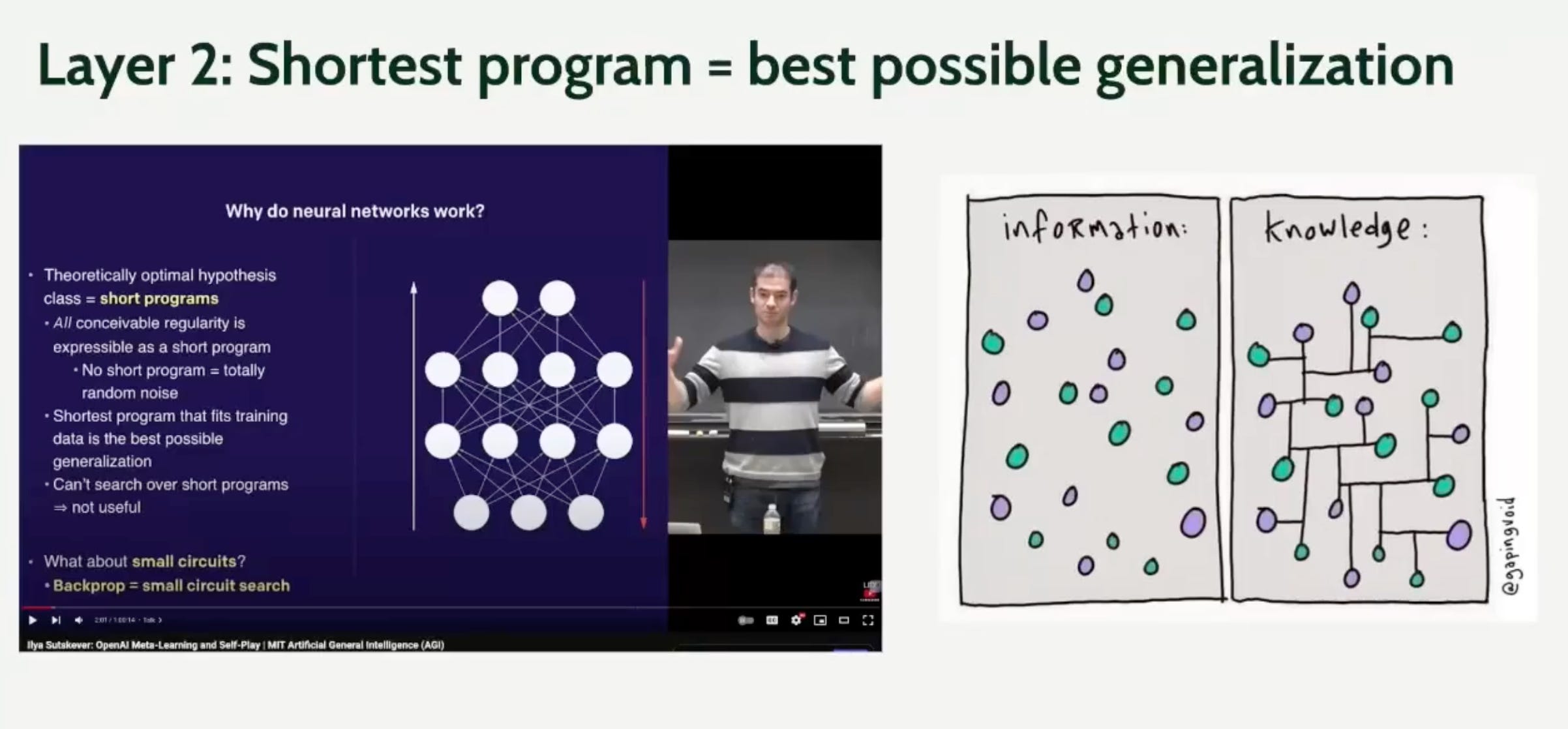
YZ: Back in 2016, Ilya Sutskever gave a talk at MIT where he asked two questions: Why does backpropagation work? And is the theoretically optimal hypothesis space equivalent to finding short programs? So, are you saying that the model was originally taking many different paths, but then it suddenly found a more efficient connection, achieved compression, and gained a stronger ability to generalize?
Yuandong Tian: Yes, “compression” is a simple but fitting way to put it. However, we still don’t really know when you can compress and when you can’t.
And that’s precisely why studying grokking is so important: it shows us a dynamic pathway of how a system transitions from an “incompressible” state to a “compressible” one.
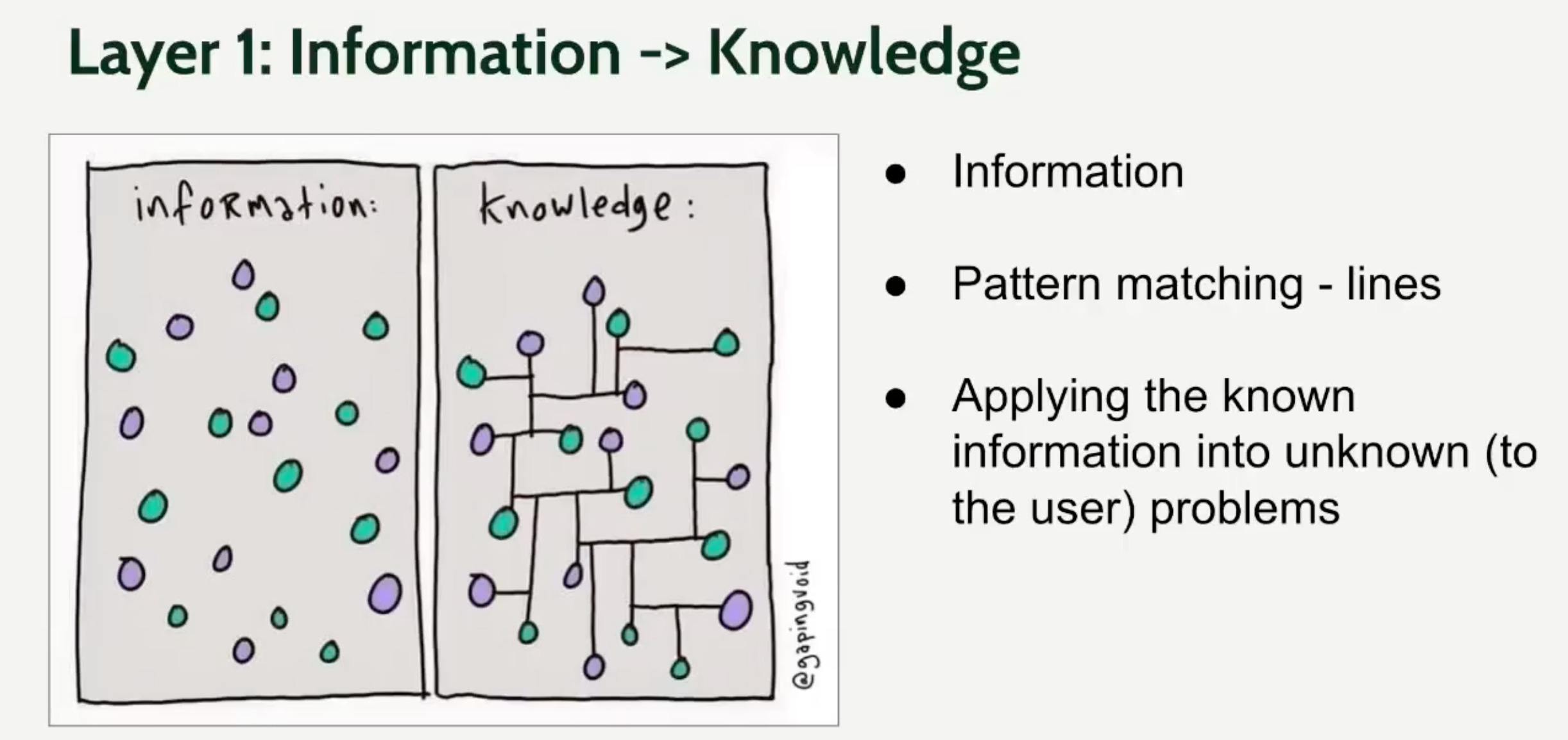
YZ: That sounds a lot like how humans learn. We also form knowledge by “connecting information.” Educational psychology tells us that prior knowledge is the most important thing—new information can only be understood when it connects with old experiences. But whether in the human brain or in large models, we don’t really know how these “connections” actually form. Maybe understanding this process is the key to unlocking the next generation of models?
Yuandong Tian: You’re absolutely right. Right now, there are two main research paths. One is to treat the system as a black box and just use scaling laws to pile on more parameters and try different configurations. The other is to “open up the machine,” understand its internal mechanisms, and then use your intuition to guide how you tune the parameters.
The black box method is more popular right now because it’s faster and cheaper to get results. But if you want to truly understand how these models work, you have to take the harder road.
YZ: Why is the black box approach more dominant? Is it because even if we “open it up,” it’s still incredibly hard for us humans to tell what’s going on inside?
Yuandong Tian: Yes, that’s a big part of it. That’s why we need to build a higher level, holistic framework for understanding—one that can unify the common principles across different learning paradigms. My goal with the grokking paper was to try to build such a framework.
In the short term, the black box approach will continue to be efficient. But in the long run, the path of understanding the mechanism has a much higher ceiling.
05. Grokking: The Mathematical Mechanics of the Leap from Memorization to Generalization
YZ: So the black box path is dominant partly because even if we do “open up the model,” it’s incredibly difficult for humans to make sense of what’s happening inside. This makes building a “grand framework” that can unify different learning paradigms all the more critical—is that why you published your work on grokking as a formal paper?
Yuandong Tian: Correct. Through systematic research, we hope to build a larger framework for understanding that can point the way for future improvements.
YZ: Let me bring in a related debate. We often draw inspiration from human learning. There are two main camps right now. Rich Sutton emphasizes that Reinforcement Learning (RL) is closer to how humans learn because it has a clear objective function. The other camp, represented by people like Hinton, argues that experience doesn’t just come from physical interaction; language can also effectively transmit experience. The core of this debate is: How do humans learn? What is learning? How do we generate new knowledge and connect the dots? Which side do you lean toward?
Yuandong Tian: I agree with the idea of learning through experience, but the more important question is, “What kind of experience is more valuable?” One view stresses that you must have embodiment—physical experience, like “traveling ten thousand miles,” “feeling emotions,” and so on—to form truly deep representations. The other view holds that abstract concepts can also be learned through language. Actually, these two are not mutually exclusive. What we’re after is a high quality representation—one that can support prediction and generalization.
How that representation is formed depends on the richness and structure of the input. You can have a mix of direct experience and abstract concepts. As long as it ultimately produces a high quality, generalizable representation, it works. The ratio doesn’t have to be black and white; it could be half and half, or one third to two thirds. The key is whether it can form a useful cognitive structure.
06. From Black Box Experiments to Mechanistic Understanding: Opening the System to Raise the Ceiling
YZ: Let’s get back to the path of “opening up the model.” What’s the practical value of doing that? Is it about more efficient learning, or is it about learning “new things” from the same amount of knowledge? When we start hitting the ceiling on data, the marginal value of efficiency seems limited.
Yuandong Tian: It’s quite the opposite. Understanding the machine is even more critical when you hit the data ceiling. If the total number of training tokens is sufficient for mainstream domains but scarce for niche areas, and your training algorithm is “data hungry,” the model is likely to get stuck in memorization rather than generalization.
At that point, relying solely on scaling laws might not work anymore. You can do data augmentation, but if you have a deeper understanding of the model’s mechanics, you might be able to improve the training algorithm or the architecture itself to learn a better representation from fewer samples.
YZ: Looking at how large models generate text, would you say the new tokens produced during inference are more a product of memorization or generalization?
Yuandong Tian: It depends on the context; it’s usually a mix of both. When you have a rich variety of tasks that cover diverse combinations, the model is more likely to learn robust representations and generalize. The more material it sees and the wider the range of combinations, the more likely it is to form a representation that also works for unseen combinations. What we call “true understanding” shows up in two ways: one is being able to give the right answer in a new situation, and the other is being able to break a problem down into simpler, more widely applicable logic.
Together, those two points form a kind of working definition of “generalization.” Conversely, if a domain has very little data and its structure is hard to capture, the model will often resort to rote memorization. Its error rate on the training set might be acceptable, but it will struggle to generalize to new samples.
YZ: So when scaling laws hit diminishing returns due to data limitations, the paradigm focused on mechanisms can create better “compressible representations” in data-scarce areas. Does this mean the latter approach will show a decisive advantage in scenarios that are high difficulty, low sample, and highly structured?
Yuandong Tian: That’s my belief. In the short term, scaling up with the black box method is still efficient. But in the long run, opening up the system to understand the dynamics of how representations form and transfer is the only way to truly raise the ceiling of what these models can do.
07. From Compressibility to Explanatory Power: The Ultimate Value of Generalization
YZ: How can we explain this leap from memorization to generalization in a more formal way? Many people see it as a mysterious “emergence.”
Yuandong Tian: We can understand it through the lens of multi modal non convex optimization. Think of it as a landscape with many peaks and valleys. Different representations correspond to different “peaks” (local optima). The data distribution determines the height of these peaks. When you don’t have enough data, the “memorization peaks” are higher. As you add more data with clearer structure, the “generalization peaks” rise, and the memorization peaks fall.
The optimization process naturally gravitates toward the highest peak. Once a generalization peak becomes just slightly higher than a memorization peak, the parameters will collectively “flip” over the ridge, which looks like a sudden “grokking” moment. It’s a clear mathematical path, not some mysterious jump.
YZ: Could we say that the correct, generalizable representation was always latent in the data, but we just hadn’t noticed it or given it enough weight? Then, as the data points grew, its value became more apparent, and we started paying attention?
Yuandong Tian: You could look at it that way, but with one condition: that structure must actually exist, and you need enough data to make its advantage significant enough to “beat” the memorization based solutions. When the evidence is weak, just memorizing is a better bet. But when the evidence is strong, the generalizable structure naturally wins out because it’s simpler and more robust.
YZ: This brings up the question of evaluation and rewards. During pretraining, the main goal is next token prediction. So in the post training phase, how do you encourage stronger generalization? And how do you avoid reward hacking?
Yuandong Tian: The pretraining loss function is relatively stable, like predicting the next word. But the post training phase is where you can get much more creative. In reinforcement learning, you can set different values, rewards, or rubrics. You can also introduce chain of thought to ensure the intermediate steps are sound, which discourages the model from taking shortcuts, like just guessing on multiple choice questions. Optimizing in different directions will strengthen different dimensions of the model’s abilities.
YZ: You mentioned a tendency toward “elegance” or “compression.” Is that tendency built into the reward function?
Yuandong Tian: It’s more like an implicit bias in the training process. Among the many possible explanations, the optimization algorithm tends to favor representations that are simpler and more compressible, which aligns with our intuition about what “elegance” is. It’s not an explicit term in the objective function but rather a direction of learning induced by the optimization process and the inductive bias, which in turn improves the quality of the representation and its ability to generalize.
08. The Loss Function Is Just a “Proxy Signal,” Not the Goal
YZ: You’ve said that the loss function we define isn’t the true objective we want to optimize, but rather a “surrogate objective.” How should we understand that idea?
Yuandong Tian: The core job of the loss function is to generate the right gradient flow to push the representation in the “correct direction.” Different loss functions can induce similar gradient structures, leading to similar learned representations.
The objective function itself isn’t the ultimate goal; it’s a computable proxy signal that enables a learnable optimization path. Many objective functions in representation learning, when you break them down, are essentially different forms of backpropagation gradients. As long as the gradient structure is similar, even if you use a different loss function, the representation you learn will be very close.
YZ: So we can imagine the “gradient” as the steepest downward path on a contour map, and these contour lines ultimately sketch out a depiction of the world’s underlying rules.
Yuandong Tian: That’s a very fitting analogy. We travel along these contour lines, searching for a structure that is simpler and can unify more phenomena. When the evidence and the inductive bias work together and reach a certain point, the model “crosses a peak” into a generalizable representation state. On the surface, it looks like an “aha!” moment, but it’s actually the natural outcome of optimization dynamics.
YZ: Going back to the relationship between memorization and generalization, does giving the model more “material to memorize” increase the likelihood of generalization?
Yuandong Tian: In many tasks, yes. The more combinations the model sees, the more robust a representation it can learn. This representation then has predictive power even for combinations it has never seen before, which is generalization. True “understanding” often manifests as an improvement in methodological ability—being able to use a few simple logical principles to uniformly explain more phenomena in new situations and extend that to even more scenarios.
YZ: What happens if the data is very sparse and the model can’t learn a good representation?
Yuandong Tian: It will tend to learn by memorizing to meet the training error target. But as soon as you go outside the training set, the error rate will spike. People usually attribute this to overfitting or memorization taking over.
09. Future Directions: Achieving “Structural Transfer” in a World of Sparse Data
YZ: When scaling laws start to fail because of data bottlenecks, what other directions can we explore besides data augmentation?
Yuandong Tian: We can use our mechanistic understanding to improve the training algorithms or model architectures to make them less “data hungry.” This would make it easier for the optimization process to reach the “generalization peak.” This is especially important in niche domains, where the data “pool” for each subdomain is very small and standard data augmentation techniques don’t work well.
YZ: Can you give us an intuitive analogy to help understand this?
Yuandong Tian: You can think of a large language model as an extremely diligent and powerful scholar. After reading three million Tang poems, it starts writing its own poetry. It’s not just reciting from memory; it’s exhausting all the patterns and forming a “method” for evaluation and self improvement.
Another path is like discovering a mathematical formula, where you directly “leap” to the underlying law itself. For example, Archimedes’ discovery of the law of buoyancy involved two steps: first, he exhausted a vast number of possibilities; second, he was able to immediately recognize, “This is the right one.” Machines currently struggle to be as efficient as humans in that second step—the “immediate recognition” part.
Here’s another example. Both the geocentric and heliocentric models could predict planetary positions, but the heliocentric model is simpler and more elegant. Once we adopt the heliocentric view, orbits become simple ellipses, and we immediately recognize it as a better explanation, one that is closer to truth and beauty. This preference for “elegance/compression” is also something that is naturally induced by implicit biases during the training process.
YZ: Above the loss function, is there an even more implicit layer of “reward”?
Yuandong Tian: You could say that. The implicit biases in the training process do guide the model to naturally discover more elegant and compressible explanations, which leads to better representations and stronger generalization. All loss functions are essentially proxies. Their purpose is to generate an effective gradient flow to drive the representation toward convergence. Their specific form is actually less important than the gradient structure itself.
YZ: I see. The contour map analogy really does help make sense of it: we follow a computable proxy signal toward a better explanation. When the “generalization peak” rises slightly above the “memorization peak,” the model’s parameters shift collectively, and we see the “grokking” phenomenon. But this “contour map” analogy is a common one, and it does ignore the structural properties of the neural network itself.
Yuandong Tian: That’s right. The analogy treats the entire loss landscape as peaks in a high dimensional space, but each of those peaks actually corresponds to a specific representation structure within the neural network’s parameter space. So, we can’t just look at the shape of the peak; we also need to pay attention to the relationship between these structures and the network itself.
YZ: In other words, the change in the gradient on the peak is actually realized through the gradient paths of each individual neuron?
Yuandong Tian: Exactly. If you could map the gradient directions back to each set of parameters and each layer of neurons in the neural network, you could observe which modules have learned what kinds of representations. While this process is quite complex and detailed, it’s very helpful for intuitively understanding the underlying mechanisms of representation learning.
10. A New Paradigm of Human-AI Collaboration: AI as a Co-creator in Research
YZ: You mentioned a shift in research paradigms. How do you see the role of AI in scientific research now?
Yuandong Tian: Exploring new research paradigms is crucial; we have to keep up with the times. We can’t keep doing research the way we used to. In the future, maybe we’ll have an “AI Scientist,” or I might write my own agent framework to help me with my research.
YZ: That sounds fascinating.
Yuandong Tian: Actually, for this paper on grokking, some of the ideas came from conversations I had with GPT-5. It feels a bit like “self play,” but during the dialogue, you have to give it some of your own insights and thoughts to get it to produce something different.
YZ: I noticed, however, that you are the sole author on that paper.
Yuandong Tian: That’s right. Conference submission rules don’t allow listing a large language model as an author. But I did mention in the paper that we made extensive use of AI. I would give the model an idea and have it try to build an argument, derive equations, and find problems. It was often wrong, but occasionally it would offer a really insightful point that helped me refine a vague idea into a concrete research plan.
YZ: I’ve had similar experiences. I once discussed some research on quantum mechanics with GPT’s o1-pro, and I felt like the AI could help me organize my thoughts, but it couldn’t write a paper with the kind of “aha!” moments that yours has.
Yuandong Tian: The key here is that the truly important insights still have to come from a human. The AI can get “stuck,” talking in circles around a concept without ever getting to the heart of it. It’s like a “new PhD student” who talks a lot but can’t quite grasp the core issue.
YZ: That’s definitely a common problem.
Yuandong Tian: So it’s up to the researcher to summarize, distill, and guide. The AI can be “trained,” but it doesn’t yet have the aesthetic sense to know when something has been “explained clearly.” And that ability to explain things clearly is itself an extremely high level skill that’s very hard to model as a loss function.
YZ: I agree. We have to first learn how to explain things clearly ourselves before we can ask a model to do it.
Yuandong Tian: Exactly. That ability to “explain clearly” embodies a depth of understanding and a sense of beauty. Figuring out how to give models that ability might be the next great scientific question to explore.
YZ: After hearing that, I have a much deeper appreciation for how AI is changing the way we do research. It’s not just a tool; it’s a mirror that makes us rethink what understanding and clear communication really are. Through this paper, we’re really exploring the process of how humans and AI can evolve together.
This piece realy made me think, especially your insightful breakdown of 'grokking'. I'm quite intrigued by the distinction between a high test score and an LLM truly learning to 'think'. Could you elaborate on what specific internal mechanisms might signal this profound cognitive shift in a model's understanding?
Fascinating. The human element of convincing product teams resonates deeply. How do we ensure ethical considerations are prioritized when models reach that grokking point? Your insights here are incredibly valuable. Really appreciate this deep dive.