


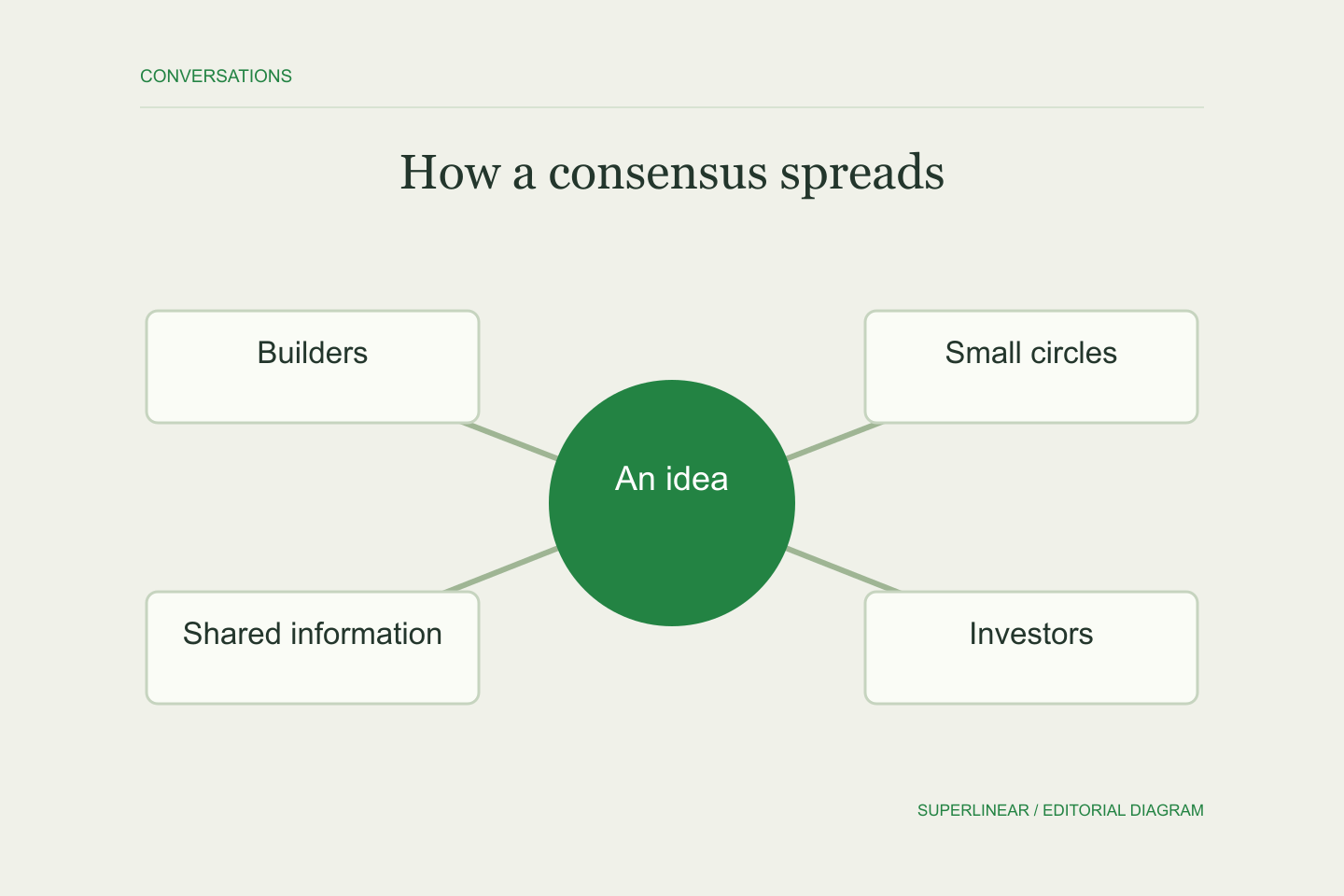
Editorial diagram of the ideas or workflow discussed in this article. It is a schematic, not measured data or a product screenshot.
Du Lei, in conversation with Yuzheng Sun. Edited account of the 2025-08-14 video, focusing on 01:16–09:59. This is a thematic article, not a verbatim transcript.
A view can feel contrarian simply because most people have not heard it yet. Du Lei opens this conversation by questioning what investors often mean by non-consensus. An idea shared throughout a small circle may be unfamiliar to the public while requiring very little independent thought from the people inside that circle.
That distinction matters when trying to learn from a fast-moving technical field. Early access to a discussion and an original understanding of the underlying problem are different advantages. They can look similar from a distance.
Ask which audience disagrees
Du describes an ecosystem in which unusual ideas spread rapidly among investors, become amplified, and turn into the next local consensus. Someone hearing the idea outside that network may experience it as a surprising insight. Within the network, it may already be conventional.
The conversation uses MCP as a dated example of different communities occupying different stages of awareness. Investors, hands-on developers, and the broader public did not necessarily understand the same thing by the technology or share the same degree of enthusiasm.
The lesson is not a prediction about a protocol’s eventual market position. It is a way to make a claim of originality more precise. Who already believes this? Who has tried it? What do they know that has not yet reached the wider conversation?
A working experiment can be ahead of a popular story
Yuzheng and Du discuss an idea that circulated as an intriguing repository: encode documents into images and package them in a video so that compression and seeking can be used in unusual ways.
In the investor conversation, this appeared as a novel possibility. In the builder community, some people had already experimented with related approaches, explored their advantages, and run into performance problems. The idea’s arrival in a new circle did not mark the beginning of its practical evaluation.
That sequence illustrates the value of firsthand work. A compelling description can travel without its implementation history. The people who built an early version may have a more conditional view because they have encountered the tradeoffs that the description leaves out.
For someone learning about a new technique, the next useful source may therefore be an experiment log rather than another enthusiastic explanation. What was built? What failed? Why did the builder continue or stop? Those details turn novelty into information that can guide a decision.
Falling costs change who gets to build
Du also offers a view of how founder profiles changed during the early AI cycle. Expensive technology initially favored people who could raise capital, organize substantial resources, or sell productivity improvements to enterprise buyers. Those capabilities made certain businesses easier to attempt.
As costs fell, he saw more room for consumer products and younger founders. He describes students who had already spent years building small projects, attending hackathons, and running communities. Their age concealed substantial practical experience.
The distinction is between a conventional résumé and accumulated attempts. A person may be young while having repeatedly found a problem, built something, shown it to others, and responded to the result. That experience can matter when the cost of starting a new experiment declines.
These observations were made in a 2025 conversation and should be read as a view from that moment. Their lasting value is the method of inquiry: inspect how information moves, look for people with direct experience, and ask which changing constraint has made a new kind of participant possible. A new consensus is more useful when you can see the work beneath it.